


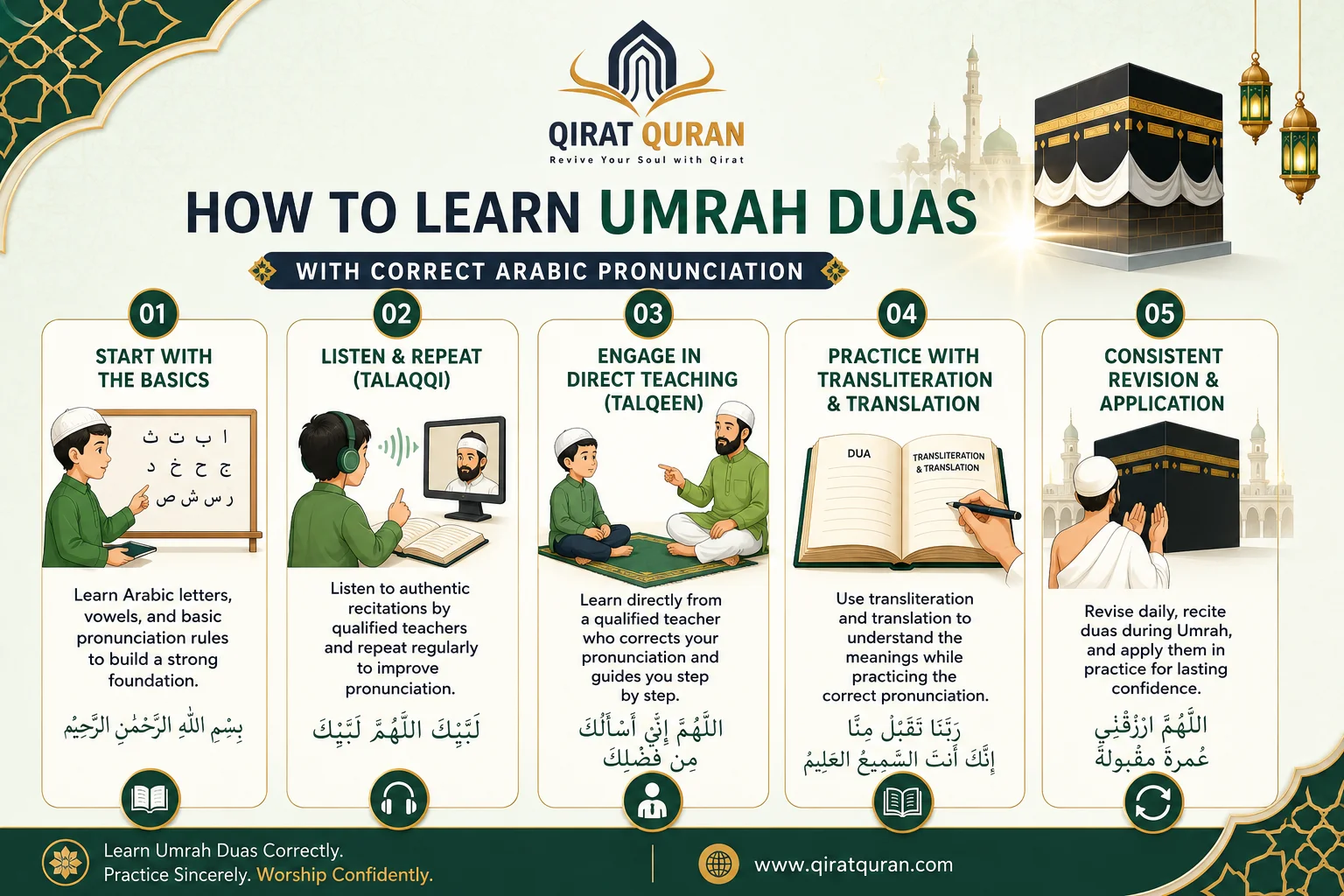
Learning the duas for Umrah is one thing. Saying them correctly is another. Many UK Muslims grow up reading Arabic without fully mastering the sounds, and by the time they start comparing Umrah packages UK travellers rely on, they suddenly realise their Talbiyah does not sound quite right. The good news? Correct pronunciation is a skill anyone can learn, at any age, with a little daily practice. This guide breaks it down into simple steps you can start today — months before you ever board the plane.
Quick answer: how do you learn Umrah duas with correct pronunciation?
Learn the Arabic letters that have no English equivalent first, then listen to a qualified reciter and repeat each dua line by line. Practise in small chunks daily, record yourself, and check your progress with a teacher at your local mosque. Most people reach a confident level within four to eight weeks.
Why correct pronunciation matters
Arabic is a precise language. Changing one letter can change the meaning of a word completely. For example, qalb (with a deep “q”) means heart, while kalb (with a soft “k”) means dog. That is why scholars encourage every pilgrim to spend time on pronunciation before Umrah — not to make the journey stressful, but so your duas mean exactly what your heart intends.
That said, keep balance. Allah accepts the dua of a sincere heart, even with an imperfect tongue. Pronunciation is something to improve, never something to fear.
Step 1: Master the tricky Arabic letters first
English speakers usually struggle with the same small group of letters. Focus on these before anything else:
- ع (‘ayn) — a deep throat sound, as in du’a and ‘Umrah. There is no English equivalent.
- ح (haa) — a breathy “h” from the throat, as in Hajj and hasanah.
- ق (qaaf) — a deep “q” from the back of the mouth, as in Quran.
- ص (saad) — a heavy “s”, as in Safa.
- ط (taa) — a heavy “t”, as in tawaf.
- خ (khaa) — the “kh” sound, as in khayr.
Ten minutes a day on these six letters will transform how your duas sound. Practise them in front of a mirror and exaggerate the sounds at first — it feels odd, but it works.
Step 2: Listen, then repeat — line by line
You cannot learn pronunciation from a book alone. The ear must lead the tongue. Choose one clear, slow reciter and stick with them:
- Play one line of the dua.
- Pause and repeat it out loud three times.
- Move to the next line only when the first feels natural.
- At the end, recite the full dua and record yourself on your phone.
Comparing your recording with the reciter is the fastest self-correction method there is. Most people are surprised how quickly their ear starts catching mistakes.
Step 3: Start with the Talbiyah
The Talbiyah — Labbayk Allahumma labbayk — is the dua you will repeat hundreds of times during Umrah, so learn it first and learn it well. Break it into four short parts and master one part per day. By the end of the week, recite it from memory during your daily routine: on your commute, while cooking, after salah.
Timing your learning with your travel plans helps too. Many UK families book december umrah packages to travel during the school holidays, when the weather in Makkah is cool and pleasant. If that is your plan, starting your pronunciation practice in October or November gives you a comfortable six to eight weeks — more than enough time to walk into Ihram with full confidence.
Step 4: Learn the meaning alongside the sound
Pronunciation improves faster when you understand what you are saying. When you know labbayk means “here I am”, the word carries feeling — and words with feeling are remembered. For every dua you learn, write three columns in a notebook: the Arabic, the transliteration, and the English meaning. Read all three together each time you practise.
Step 5: Get feedback from a real person
Apps and recordings take you far, but nothing replaces a human ear. Most UK mosques run free tajweed classes, and many imams are happy to listen to your Umrah duas after salah and correct you kindly. Even two or three short sessions can fix mistakes you would never notice on your own. If you cannot get to a mosque, ask a family member who reads well, or book a short online tajweed session.
Common pronunciation mistakes to avoid
- Rushing the Talbiyah. Slow recitation is clearer and more sincere.
- Flattening the heavy letters. Safa with a light “s” is a different word.
- Skipping the ‘ayn. Saying “Umrah” without the throat sound is the most common mistake among English speakers.
- Learning too much at once. One dua learned well beats ten learned badly.
- Silent practice. Pronunciation lives in the mouth, not the mind — always practise out loud.
Frequently Asked Questions (FAQs)
With ten to fifteen minutes of daily practice, most people are confident within four to eight weeks.
Yes. Sincerity comes first. Scholars agree that honest effort is what counts, and Allah knows the intention behind every tongue.
Yes, outside of the formal prayer you may read duas from your phone or a small book. Only the Talbiyah is best memorised.
Any age. Children pick up sounds quickly, but adults learn well too — consistency matters far more than age.
Final thoughts
Learning Umrah duas with correct pronunciation is not about perfection — it is about respect, effort and love for the words you will say in the holiest place on earth. Start small, practise daily, listen more than you read, and let a teacher polish the rest. By the time you stand before the Kaaba, the words will flow from your heart as naturally as your breath. May Allah make it easy for you and accept your Umrah. Ameen.
